
Introduction
Most people know they need to save for retirement. But very few actually know how much they need. They guess. They hope. They trust that saving something will be enough. The truth is, without a clear number, your retirement planning is just wishful thinking.
That’s where AI changes everything. Today, AI-powered retirement tools don’t just give you a rough estimate they calculate your future retirement corpus based on your real income, spending habits, inflation, life expectancy, and even market behavior. The result is a personalized projection that feels less like guesswork and more like a financial blueprint.
In this guide, you’ll learn exactly how AI predicts your retirement corpus, which tools are worth your time, and how to build an action plan around what the AI tells you.
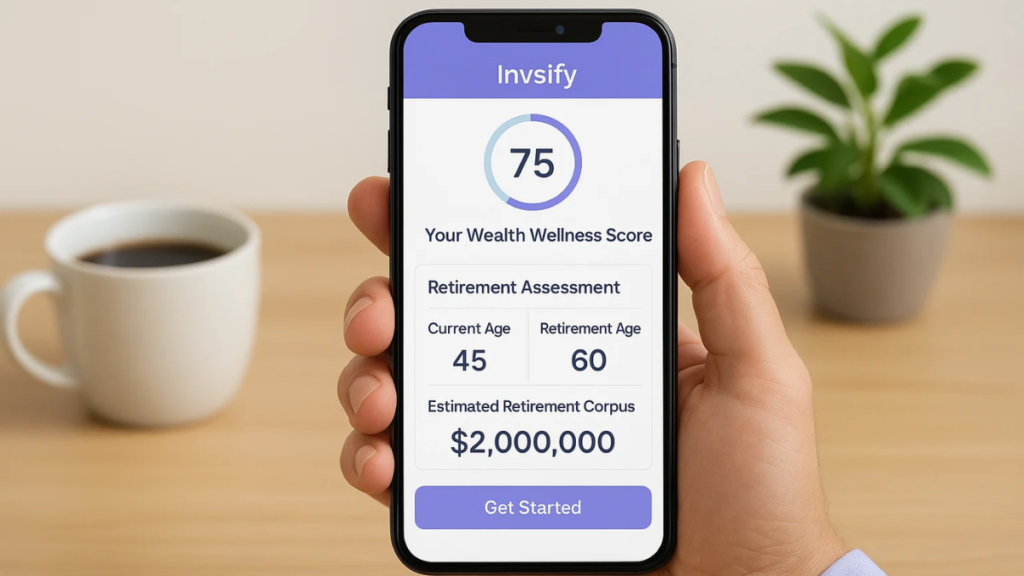
What is a Retirement Corpus?
A retirement corpus is the total amount of money you need to have saved by the time you stop working enough to fund your entire lifestyle for the rest of your life without depending on anyone else. Think of it as your personal financial finish line. If you cross it before retirement, you’re in great shape. If you don’t, every year in retirement becomes a slow countdown to running out of money.
The exact number varies massively from person to person. Someone who plans to retire at 45 in a big city needs a far larger corpus than someone retiring at 65 in a smaller town. Variables like monthly expenses, healthcare costs, travel goals and expected rate of return all play a role. This complexity is exactly why a simple savings account or mental math simply doesn’t cut it anymore.
- 64% of people have no retirement savings target
- 25x annual expenses is the popular retirement corpus benchmark
- 6–7% average inflation-adjusted return AI models use
Why Traditional Calculators Fall Short
You’ve probably used a basic retirement calculator before. You type in your age, current savings and expected return and it spits out a number. Clean and simple. But also, dangerously incomplete. Standard calculators assume a fixed rate of return every single year. Real markets don’t work that way. They go up, they go down and sometimes they crash at the worst possible time right when you’re about to retire.
They also ignore lifestyle changes. You’re spending in your 60s is very different from your spending in your 40s. Healthcare costs tend to rise. Travel might slow down. Your income sources shift from salary to withdrawals. A one-size-fits-all calculator can’t account for any of this.
Perhaps most importantly, traditional calculators often use a single average inflation number say 6% across the entire projection. But inflation doesn’t behave that uniformly. Medical inflation in some countries runs at twice the general rate. Rent, food and fuel all move differently. AI models account for these nuances, and that’s what makes the difference between a good estimate and a reliable one.
How AI Models Your Retirement
When you use an AI-powered retirement tool, what’s actually happening behind the scenes is far more sophisticated than a simple formula. Most modern AI retirement planners use a technique called Monte Carlo simulation. Instead of running your numbers through one fixed scenario, the AI runs thousands of different scenarios each with slightly different market returns, inflation rates, and life events and then tells you the probability that your money will last.
For example, it might say: “Based on your current savings rate, there’s a 78% chance your money lasts through age 85.” That kind of probabilistic thinking is something no basic spreadsheet can replicate.
Beyond simulations, AI tools also personalize their models based on your behavior. If you connect your bank account or investment portfolio, the AI can see your actual spending patterns, your real income fluctuations, and your existing assets. It then builds a model that reflects your actual life not a theoretical average person’s life. AI retirement tools use techniques like Monte Carlo simulation, behavioral spending analysis, and real-time portfolio data to give you a probability-based retirement projection not just a single estimate number.
Top AI Retirement Planning Tools
There are several genuinely useful AI-powered retirement planning tools available right now, ranging from free options to professional-grade platforms.
Personal Capital (Empower)
One of the most comprehensive free tools available. Connect all your financial accounts and get an AI-powered retirement readiness score. Its Retirement Planner runs Monte Carlo simulations and shows you a clear probability of success based on your current trajectory. Excellent for beginners and intermediate planners alike.
Betterment
A robo-advisory platform with strong AI retirement projection features. It adjusts your portfolio automatically as you age and shows you how close you are to your retirement goal with each contribution. The “RetireGuide” feature breaks down exactly what you need to do each month to hit your target.
Wealthfront Path
Wealthfront’s AI engine, called Path, is one of the most advanced retirement planning tools available to regular investors. It factors in Social Security estimates, home equity, partner income, and planned large expenses to give you a genuinely customized retirement projection. Available through the Wealthfront app.
ChatGPT + Custom Prompts
For those comfortable with a DIY approach, you can use ChatGPT to build a highly customized retirement projection. Feed it your income, monthly expenses, current investments, expected retirement age, and desired lifestyle and ask it to model different scenarios. It won’t connect to live market data, but for planning frameworks and scenario analysis, it’s surprisingly powerful.
MaxiFi Planner
Designed specifically for people nearing retirement, MaxiFi uses AI-driven economic modeling to optimize your retirement income strategy including when to claim Social Security, how to draw down different accounts, and how to minimize lifetime taxes. A premium tool worth it for those within 10 years of retirement.
Inflation Adjustment in AI Projections
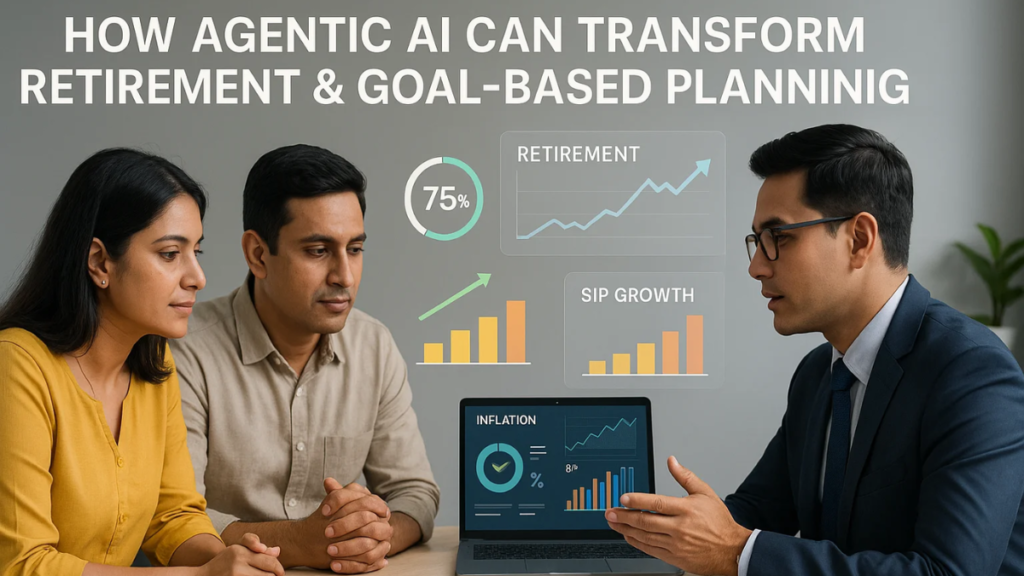
This is where most people get blindsided and where AI adds the most value over traditional calculators. Imagine you calculate that you need $500,000 to retire comfortably today. That same lifestyle will cost significantly more in 20 years thanks to inflation. If inflation averages 5% annually, that $500,000 need grows to over $1.3 million in real terms by the time you actually retire.
AI tools don’t just apply a flat inflation number. Better platforms separate inflation by category. They might apply a 4% general inflation rate, a 7% healthcare inflation rate and a 3% housing inflation rate then blend these based on what your projected spending looks like across each category.
Some tools also account for sequence of returns risk the danger that a market crash early in your retirement wipes out a much larger portion of your savings than a crash later would, simply because you’re drawing down funds while the market is falling. AI models can stress-test your corpus against this specific scenario and recommend adjustments before it becomes a crisis. A $500,000 retirement target today becomes roughly $1.3 million in 20 years at 5% average inflation. AI retirement tools account for this automatically traditional calculators often don’t.
Building Your AI Retirement Roadmap
Once you have your AI-generated corpus projection, the real work begins. Here’s a practical approach to turning that number into an actual plan. Start by getting your baseline number. Use any of the tools listed above to find out your target corpus based on your current age, expected retirement age and desired monthly expenses in retirement. Don’t skip the inflation adjustment it’s the most important part.
Next, find your current gap. Compare your target corpus with what you currently have saved and what you’re projected to accumulate at your current savings rate. Most AI tools will show you this gap clearly and it can be sobering. That’s fine. A clear picture is the first step to fixing it. Then use the AI to model scenarios. What happens if you increase your monthly savings by 10%? What if you delay retirement by two years? What if you shift your portfolio to a slightly more aggressive allocation? AI tools let you run these scenarios instantly, so you can see the real impact of small changes before you commit to them.
Finally, automate what you can. Set up automatic contributions to your retirement account. Use robo-advisors like Betterment or Wealth front to keep your portfolio rebalanced without lifting a finger. The more you automate, the less likely you are to deviate from the plan when life gets complicated. Revisit your projection at least once a year or any time there’s a major change in your income, expenses or financial goals. AI tools make this process much faster than it used to be, so there’s no excuse for letting your plan go stale.

FAQ’s
Q1. How accurate are AI retirement corpus predictions?
AI tools are significantly more accurate than simple calculators because they account for variable market returns, inflation by category and behavioral spending data. That said, no tool can predict the future with certainty the best one’s express results as probabilities (e.g., 85% chance of success) rather than single fixed numbers. Use them as planning guides, not guarantees.
Q2. Can I use AI retirement tools even if I’m just starting out?
Absolutely in fact the earlier you start using them, the better. Tools like Personal Capital and Betterment are designed for beginners. Starting early gives the AI more time horizon to work with and small changes now have a huge compounding effect over decades.
Q3. Is my financial data safe with these AI tools?
Reputable platforms like Personal Capital, Betterment and Wealth front use bank-level encryption and read-only connections to your financial accounts meaning they can view data but cannot move your money. Always verify a platform’s security certifications before connecting your accounts.
Q4. What is a good retirement corpus amount to aim for?
A commonly used benchmark is 25 times your expected annual expenses in retirement this is based on the 4% safe withdrawal rate. So, if you plan to spend $40,000 per year, your target corpus would be $1 million. However, this is a starting point, not a universal rule. Your AI tool will give you a more personalized number based on your specific situation.
Q5. How often should I update my AI retirement projection?
At minimum, review and update your projection once a year. Also revisit it after any major financial change a new job, a raise, a large purchase, marriage, children or a shift in your retirement timeline. AI tools make these updates quick, so there’s no reason to let your plan become outdated.
Conclusion
Retirement planning used to feel like throwing darts in the dark. You’d pick a savings rate, hope for the best, and discover too late whether it was enough. AI has fundamentally changed that dynamic.
Today, you can get a personalized, inflation-adjusted, probability-based projection of your retirement corpus often in minutes and often for free. The tools are accessible, the process is straightforward, and the clarity you gain is worth far more than the time it takes to set things up. The best time to build your AI retirement roadmap was years ago. The second-best time is right now.
Ready to find your retirement number? Start with Personal Capital’s free Retirement Planner or Wealth front’s Path tool both take less than 10 minutes to set up and will give you a clearer picture of your financial future than you’ve ever had. For more guides on AI finance tools, explore our articles on AI portfolio rebalancing for beginners and how AI micro-investing apps grow your savings.

Wasim Akram is the Founder of LuxuryGole and a dedicated Tech Expert with over 10 years of experience in the digital ecosystem. Specializing in smartphone optimization, hidden software hacks, and digital security, Wasim focuses on providing premium, actionable insights to help users master their technology. His decade-long journey in the tech space ensures that every guide on LuxuryGole is backed by deep research and practical expertise. Connect with him on LinkedIn and Facebook for daily tech updates